

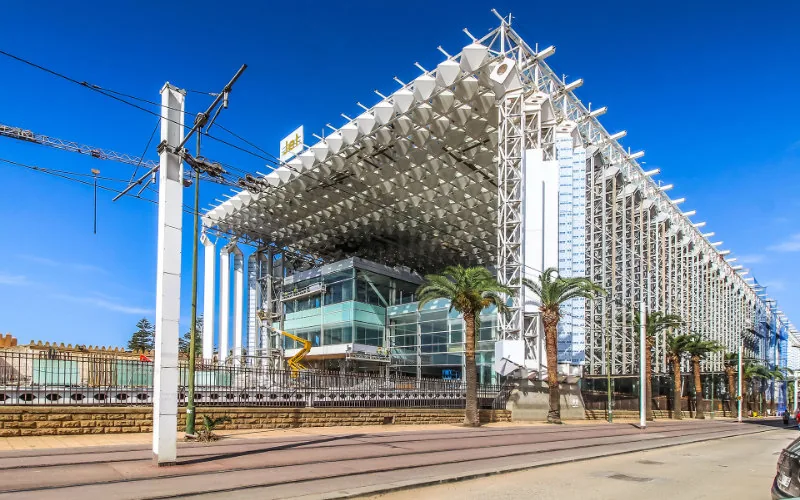
Morocco is entering one of the most important infrastructure cycles in its modern economic history.
Airports, high-speed rail, urban mobility, tourism capacity, stadium infrastructure, water systems and digital logistics are all moving through an accelerated investment phase ahead of the 2030 FIFA World Cup and the country’s wider development agenda.
The scale is large enough to matter at macroeconomic level.
The International Monetary Fund estimates that Morocco’s public infrastructure investment scale-up between 2024 and 2030 amounts to around 12% of 2024 GDP, making the cycle one of the central variables shaping the country’s medium-term growth path.
For Morocco, the challenge is no longer ambition.
The challenge is efficiency.
The country is not short of projects. The real test is whether the 2030 investment cycle can convert public capital expenditure into long-term productivity, tourism throughput, private-sector opportunity and domestic corporate capacity.
If executed well, the cycle can strengthen Morocco’s economic base beyond the tournament.
If execution weakens, the risks are familiar: cost overruns, import leakage, deadline compression and assets that underperform after the event.
Timeline Compression: The World Cup as a Capex Accelerator
The 2030 World Cup is acting as an infrastructure accelerator.
Morocco was already investing in logistics, transport, energy, tourism and urban development before the hosting cycle. The tournament has compressed timelines and increased delivery urgency.
That matters because infrastructure spending affects the economy through several channels at once.
It supports construction demand.
It improves transport connectivity.
It expands tourism capacity.
It creates contracts for engineering, materials, services and labour.
It also improves long-term competitiveness if the assets remain productive after the event.
The highest-value infrastructure cycle is not the one that only delivers projects on time.
It is the one that leaves behind durable national capacity.
That is Morocco’s core benchmark before 2030.
Aviation Hubs: The MAD 38 Billion Throughput Test
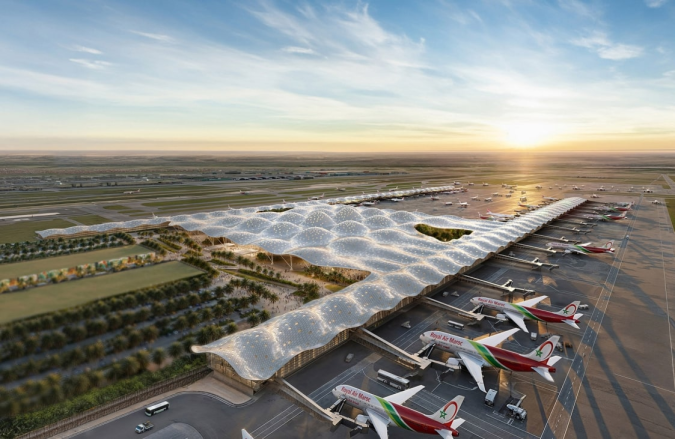
Airports are the clearest expression of Morocco’s 2030 infrastructure push.
The National Airports Office, ONDA, has launched a MAD 38 billion airport-development programme designed to raise national airport capacity to 80 million passengers by 2030.
The logic is not only event readiness.
Airports are tourism infrastructure, investment infrastructure and trade infrastructure.
Casablanca, Marrakech, Agadir, Rabat, Tangier and other gateways must process higher passenger flows while preserving service quality, border efficiency, baggage reliability and onward connectivity.
The efficiency test is therefore operational.
A terminal expansion has limited economic value if passenger flows, immigration capacity, luggage systems, ground transport, hotel access and city mobility cannot absorb higher volumes.
Morocco’s airport strategy is not only about building larger terminals.
It is about building a national throughput system.
Casablanca Mohammed V: The Crown Jewel of Airports 2030
The most important aviation project in the 2030 cycle is the expansion of Casablanca Mohammed V International Airport.
The project is the strategic centrepiece of Morocco’s airport modernisation programme.
A Moroccan consortium of SGTM and TGCC has secured the contract to build the new terminal at Mohammed V Airport, with reported project value around MAD 12.87 billion. The new H-shaped facility is expected to cover around 600,000 square metres, handle 20 million passengers annually in its initial configuration and scale toward 30 million passengers.
The terminal is also designed to connect directly with the Tangier-Marrakech high-speed rail line.
That integration matters.
Casablanca is not only an airport project. It is the hub architecture for Morocco’s 2030 mobility system.
If executed properly, Mohammed V can become a more powerful international gateway linking air traffic, high-speed rail, national tourism flows and business travel.
The execution risk is equally clear.
A hub of this scale must deliver passenger-processing speed, baggage reliability, rail integration, airside capacity, border control efficiency and commercial service quality.
The project’s success will be judged by operational performance, not architectural ambition alone.
Marrakech and Agadir: Local Contractors and the Domestic Multiplier

The 2030 airport cycle is also creating a domestic construction multiplier.
ONDA has awarded major airport expansion contracts to Moroccan heavyweights rather than relying entirely on foreign mega-consortia.
Jet Contractors secured the Marrakech-Menara airport expansion contract with a bid of around MAD 2.2 billion. The project is designed to expand the passenger terminal to approximately 142,000 square metres and increase annual capacity from 9 million to 16 million passengers.
SGTM won the parallel Agadir Al Massira expansion package, also valued at about MAD 2.2 billion. The project is expected to increase capacity from around 3 million to 7 million passengers annually, while upgrading terminal organisation, road access and exterior infrastructure.
This is important because it shifts the infrastructure story from spending to domestic absorption.
Rabat’s capacity to maximise its infrastructure multiplier depends on how much capital remains inside the Moroccan corporate and banking ecosystem.
By awarding major packages to local contractors such as Jet Contractors, SGTM and TGCC, the state is helping convert public infrastructure spending into domestic corporate capacity.
That reduces one of the classic emerging-market risks: infrastructure booms that become current-account drains because most engineering, materials, equipment and profits flow abroad.
The stronger outcome is different.
Imported capital goods are still needed, but Moroccan firms capture more execution value, build larger order books, deepen technical capability and strengthen their balance sheets.
Jet Contractors’ near-MAD 9 billion order book and bond-market activity underline how the 2030 cycle is also feeding capital-market depth among domestic contractors.
That is the multiplier evidence investors should watch.
High-Speed Rail: The Network Effect
Rail is the second major pillar of the 2030 infrastructure cycle.
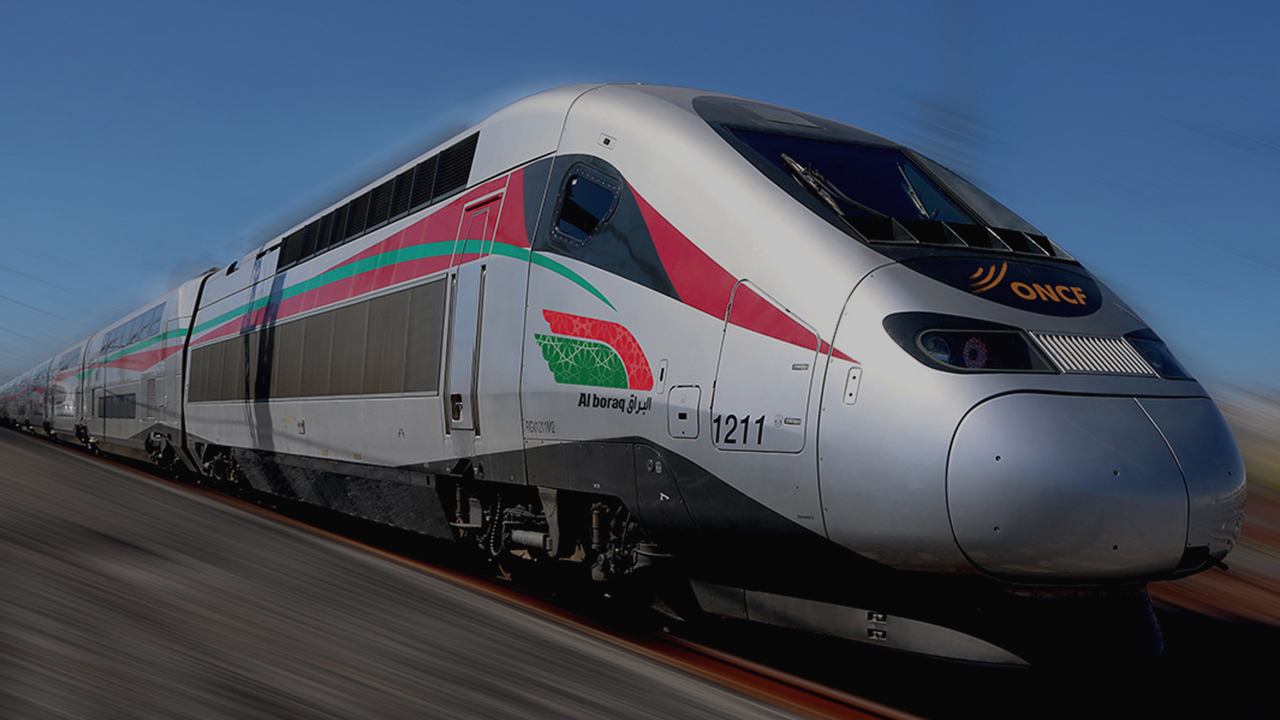
King Mohammed VI has launched a MAD 96 billion national rail expansion programme, including the MAD 53 billionKenitra-Marrakech high-speed line. The line will run about 430 kilometres, serving Rabat and Casablanca before reaching Marrakech.
The project is designed to reduce travel time between Marrakech and Tangier to around 2 hours and 40 minutes, while cutting travel between Rabat and Casablanca’s main airport to around 35 minutes.
This is not only event infrastructure.
It is a productivity asset.
Faster rail can improve labour mobility, tourism flows, airport access, city integration and regional economic depth.
Colas has secured contracts worth nearly €430 million for the Kenitra-Marrakech high-speed line. Its Moroccan subsidiary GTR has been selected for civil engineering work worth nearly €180 million, reinforcing the role of domestic execution inside an international rail programme.
ONCF has also signed train-purchase agreements worth MAD 29 billion, with Alstom supplying Avelia Horizon double-decker high-speed trains capable of carrying 640 passengers and operating at 320 km/h cruising speed.
The network effect is the real economic question.
Rail investment creates long-term value when it changes how people, labour and tourists move across the country.
If the line strengthens airport access, intercity business travel and year-round tourism beyond peak seasons, the return extends far beyond 2030.
If ridership remains event-concentrated, the productivity gain is weaker.
The Network Effect: Converting Asset Volumes Into Multiplier Yields
Infrastructure creates short-term GDP support through construction.
The long-term gain depends on multiplier yield.
That means the extent to which airports, rail lines, roads, urban systems and tourism facilities reduce friction across the economy.
A larger airport is valuable if it improves tourism throughput.
A high-speed rail line is valuable if it raises labour mobility and connects cities more efficiently.
A stadium zone is valuable if it supports hospitality, retail, transport and civic use after the tournament.
A road upgrade is valuable if it reduces daily congestion, not only event traffic.
This is the economic test of Morocco’s 2030 cycle.
The country’s advantage is that many of its projects are not isolated event assets. They fit into existing national priorities: tourism, logistics, mobility, industrial growth and regional integration.
That increases the chance of productive legacy.
But efficiency remains decisive.
The capital deployed must produce long-term usage.
The Import Leakage Problem
Large infrastructure cycles can create a hidden macroeconomic cost: import leakage.
When a country accelerates investment in terminals, trains, rail systems, machinery, construction technology and specialised equipment, part of the spending flows abroad.
That is not a failure.
It is normal for complex infrastructure.
The policy question is how much domestic value can be captured alongside imported technology.
Morocco’s current cycle shows a deliberate attempt to retain more value locally.
The aviation contracts awarded to Jet Contractors, SGTM and TGCC show that local companies are not peripheral subcontractors. They are winning strategic packages.
The rail programme also combines foreign technology with Moroccan civil-engineering participation.
This is how infrastructure spending can become corporate capacity-building.
The strongest outcome is not domestic isolation.
It is smart integration: foreign technology where needed, Moroccan contractors where possible, and long-term skills transfer built into delivery.
Urban Mobility: Avoiding the Event-Corridor Trap
World Cup infrastructure is not only about airports and rail.
It is also about how cities function.
Casablanca, Rabat, Marrakech, Tangier, Agadir and other host or support cities will need stronger urban mobility, road access, public transport, pedestrian systems, parking, security coordination and visitor flows.
Urban mobility is where major events often succeed or fail.
Visitors remember airports and stadiums.
But they also remember congestion, signage, transport reliability, transfers, safety, cleanliness and service coordination.
For residents, the long-term test is more important.
If new mobility investments reduce daily congestion after 2030, the infrastructure cycle becomes a civic productivity gain.
If improvements remain concentrated around event corridors, the legacy is weaker.
Morocco’s opportunity is to use the World Cup deadline to accelerate systems that were already needed.
That is how event-driven spending becomes structural development.
Tourism Capacity and Service Quality

Tourism is one of the clearest beneficiaries of the 2030 cycle.
Airport expansion, rail upgrades and city improvements are all designed to support higher visitor volumes.
But tourism capacity is not only hotel supply.
It includes air access, airport processing, rail transfers, road movement, short-term rental regulation, hospitality labour, medical readiness, visitor information, digital booking systems and destination management.
Morocco’s tourism opportunity is substantial.
But the sector must avoid building only for tournament demand.
The real return comes if the World Cup increases Morocco’s long-term share of global tourism flows.
That requires infrastructure, but also service quality.
The tournament can bring visibility.
Operational excellence converts visibility into repeat demand.
Fiscal Discipline and Deadline Compression
Morocco’s 2030 infrastructure cycle is large enough to matter for the fiscal framework.
The IMF projects Morocco’s real GDP growth at 4.4% in 2026, supported by agricultural recovery and public infrastructure investment. It also expects the medium-term fiscal path to remain consistent with debt-to-GDP gradually declining toward 60.5% by 2031.
That balance matters.
Infrastructure can support growth, but only if financing, delivery and long-term utilisation remain disciplined.
The risk in major event cycles is deadline compression.
As 2030 approaches, procurement timelines tighten. Contractors face capacity pressure. Materials and labour costs can rise. Public agencies must manage multiple projects simultaneously.
That is why cost control matters as much as ambition.
Morocco’s credibility will depend on delivering assets that are not only completed on time, but also financially and operationally useful after the tournament.
Private-Sector Opportunity
The 2030 cycle creates opportunities across multiple sectors.
The most immediate beneficiaries are construction, engineering, transport, hospitality, digital systems, facility management, healthcare, security technology, tourism operations, logistics and real estate.
But the strongest private-sector winners will not be those tied only to event deadlines.
They will be companies that serve long-term usage.
A hotel dependent only on tournament demand is vulnerable.
A transport operator connected to airport-city flows can build recurring demand.
A facilities-management company tied to stadiums, airports or rail hubs can generate long-term service revenue.
A digital infrastructure provider supporting ticketing, passenger flows, baggage systems or visitor data can become part of the post-2030 operating layer.
The investment thesis is not the event.
It is the operating economy around the event.
MMO 2030 Infrastructure Efficiency Matrix
Aviation hubs
2026 macro market signal: ONDA’s MAD 38 billion strategy targets 80 million passengers by 2030; Mohammed V’s new Casablanca hub has been awarded to SGTM-TGCC, while Jet Contractors and SGTM are executing major Marrakech and Agadir expansions.
Core efficiency test: real-world passenger throughput, border-processing agility, baggage reliability and airport-city integration during peak travel spikes.
High-speed rail
2026 macro market signal: Morocco’s MAD 96 billion rail programme includes the MAD 53 billion Kenitra-Marrakech high-speed line; Colas contracts total nearly €430 million, with GTR handling key civil works.
Core efficiency test: post-2029 ridership, airport connectivity, labour mobility and asset utilisation outside tourist peak seasons.
Domestic contractor multiplier
2026 macro market signal: Jet Contractors, SGTM and TGCC are capturing strategic packages across airport expansion, with Jet Contractors leveraging a near-MAD 9 billion order book.
Core efficiency test: whether public infrastructure liquidity strengthens domestic balance sheets, skills, subcontractor networks and capital-market depth.
Urban mobility
2026 macro market signal: host and support cities require road, public-transport, smart-transit and visitor-flow integration.
Core efficiency test: avoiding isolated event-corridor development and ensuring upgrades reduce long-term civic congestion.
Macro fiscal cap
2026 macro market signal: public infrastructure scale-up is modelled at around 12% of 2024 GDP, while the debt-to-GDP path is targeted toward 60.5% by 2031.
Core efficiency test: strict delivery discipline, cost control, maintenance planning and post-event utilisation.
What Investors Should Watch Next
Investors should monitor five signals as Morocco moves through the 2030 infrastructure cycle.
First, whether airport expansion improves actual passenger throughput rather than only headline capacity.
Second, whether rail upgrades reduce travel times and strengthen intercity economic integration.
Third, whether local contractors convert major awards into balance-sheet strength and technical capacity.
Fourth, whether urban mobility upgrades benefit residents after the event.
Fifth, whether public investment remains consistent with fiscal discipline and long-term productivity.
These signals will determine whether Morocco’s 2030 cycle becomes a one-time spending surge or a durable development platform.
Final Outlook
Morocco’s 2030 infrastructure cycle is one of the most important economic stories of the decade.
The country is expanding airports, high-speed rail, urban mobility and tourism capacity at a scale large enough to influence growth, private investment and international perception.
But the defining issue is not ambition.
It is efficiency.
The strongest outcome is not simply hosting a successful tournament.
It is converting the infrastructure cycle into long-term productivity, domestic corporate capacity, tourism depth and regional competitiveness.
For Morocco, 2030 is the deadline.
The legacy will depend on what the infrastructure does after the deadline.