
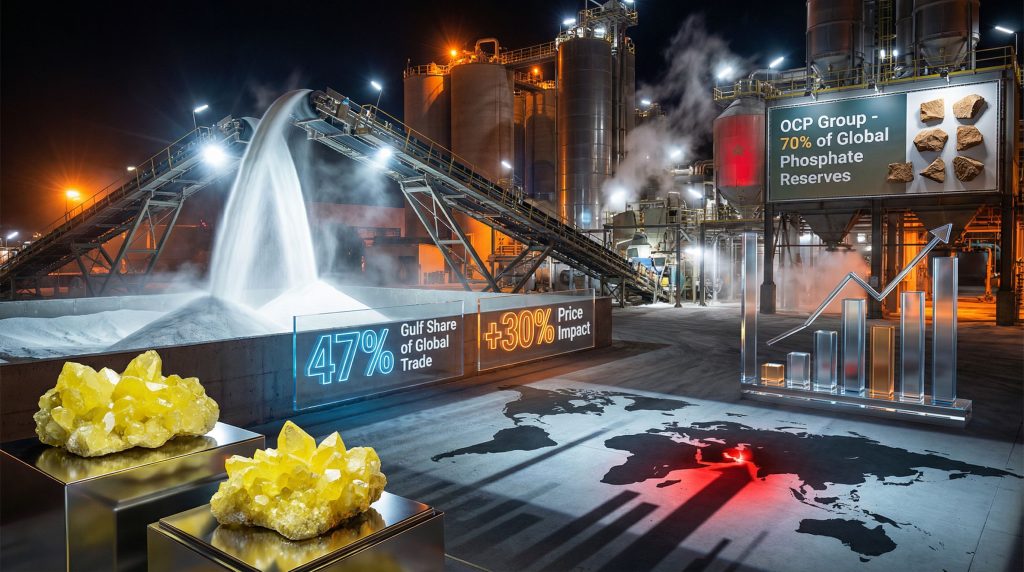
Morocco’s phosphate advantage is no longer a commodity story. It is becoming a fertilizer-security firewall built around OCP’s balance sheet, product flexibility, input-risk management and green ammonia strategy.
OCP’s 2024 financials give the scale: revenue of $9.76 billion, EBITDA of $3.93 billion, a 40% EBITDA margin, capex of $4.38 billion and net income of $2.10 billion. In April 2026, OCP added a second market signal by raising $1.5 billionthrough its first international hybrid bond, with nearly $7 billion in orders and 4.6x oversubscription.
The high-alpha question is not whether OCP has phosphate reserves. The market already knows that. The question is whether OCP can convert reserves, capital-market access, input control and African distribution into a defensive food-security platform during a more volatile global fertilizer cycle.
The Disruption: Fertilizer Is Becoming an Input-Risk Market
Fertilizer markets are being repriced around input security. Phosphate depth still matters, but production resilience now depends on sulphur, ammonia, energy, port capacity, freight routes, inventory discipline and customer delivery.
Reuters reported that fertilizer supply tightened amid Iran-related tensions and China’s export restrictions, while sulphur prices rose 35% due to disruptions linked to the Strait of Hormuz. OCP said it had sufficient sulphur stock through at least June, sourced from multiple global suppliers.
Shock map
Macro Shock: Strait of Hormuz disruption
Supply Friction: Sulphur +35%
Corporate Defense: Multi-source stock through at least June
Operational Pivot: TSP targeted at more than 50% of 2026 production
Investor Test: Margin protection under input-cost stress
The market implication is direct. Fertilizer producers are being judged less by headline capacity and more by whether they can keep producing when input markets break down.
The TSP Pivot: Product Mix as Margin Insulation
OCP’s strongest near-term defense is product-mix flexibility. Reuters reported that OCP is shifting toward triple superphosphate, or TSP, which is less reliant on sulphur and ammonia. The group is targeting TSP at more than 50% of production in 2026, up from 30% in 2025.
That pivot provides immediate margin insulation. It decouples part of OCP’s production exposure from erratic spot-market pricing in sulphur and ammonia, while giving the group more flexibility during freight or input disruption.
Operational impact
2025 TSP share: 30%
2026 target: more than 50%
Cost benefit: lower sulphur and ammonia dependency
Market benefit: stronger production resilience during input shocks
This is the core of the OCP firewall: not only owning phosphate, but actively redesigning production exposure around the weakest links in global fertilizer supply.
The Balance-Sheet Defense
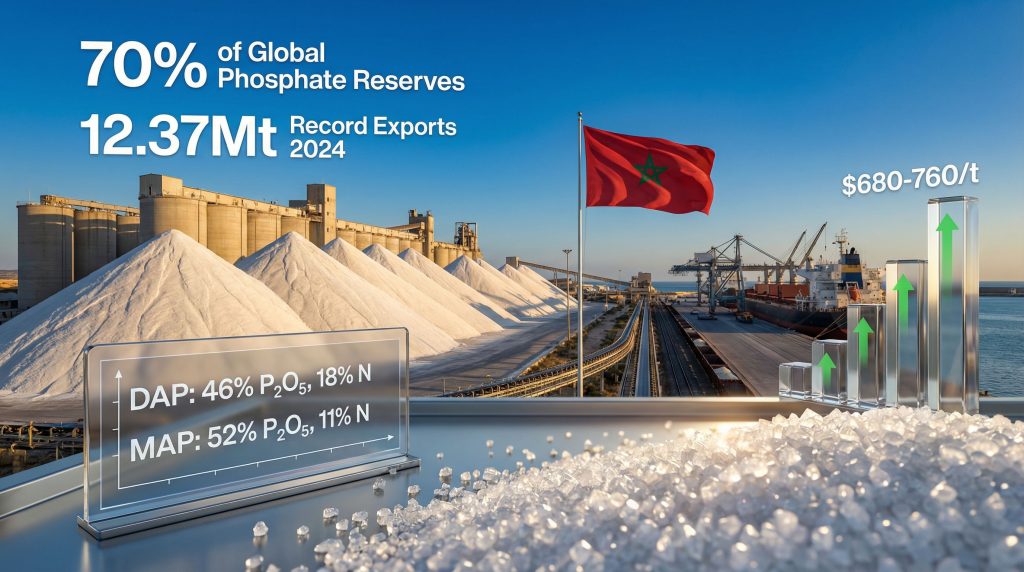
Fertilizer security is capital intensive. Processing plants, storage, ports, green ammonia, desalination, energy infrastructure and African distribution require long-duration financing.
OCP’s April 2026 hybrid bond gives the group additional funding flexibility during a fragile market window. Reuters reported that the transaction was split into two tranches maturing in April 2031 and April 2036, with coupons of 6.74%and 7.37%, and involved 176 investors from 23 countries.
Capital-market signal
Issue size: $1.5 billion
Order book: nearly $7 billion
Oversubscription: 4.6x
Investor base: 176 investors from 23 countries
Strategic function: funding flexibility for capex-heavy expansion
The bond is not just a financing event. It shows that OCP can access global capital markets while fertilizer supply chains are under stress. That balance-sheet access is part of the competitive moat.
Africa Capture: Fertilizer Demand Is a Productivity Market
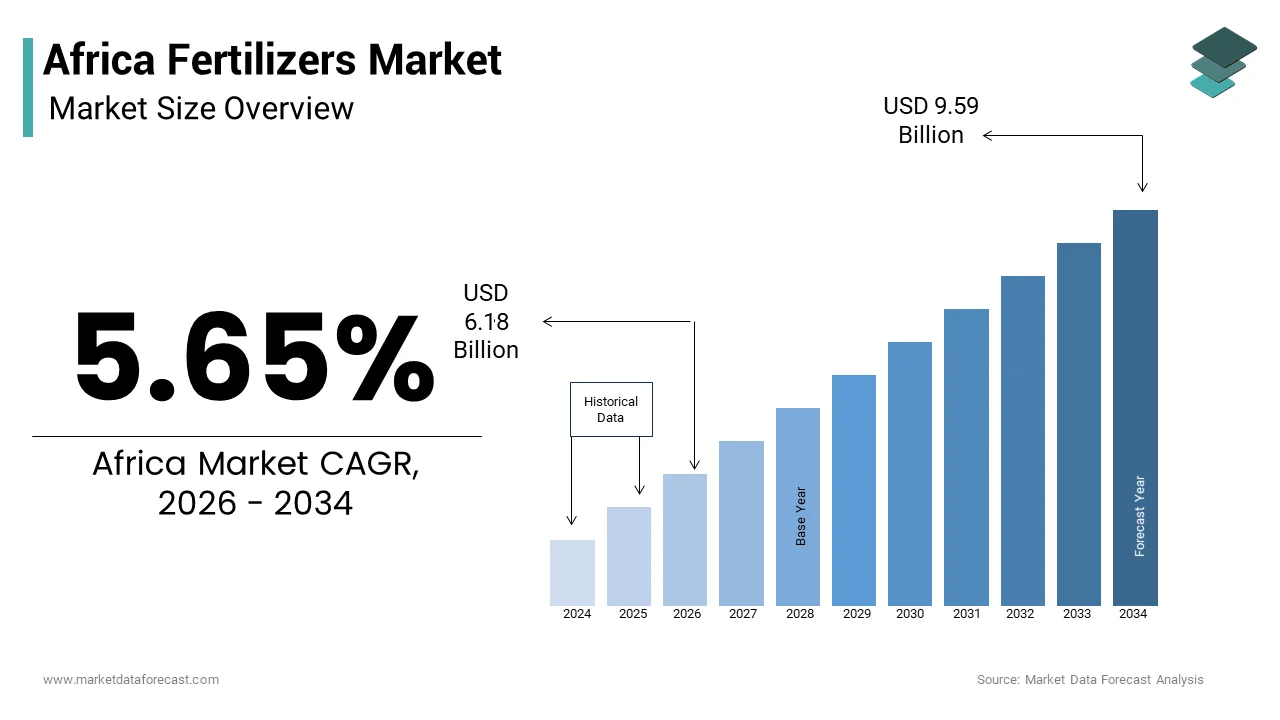
Africa is not only a volume-growth market. It is a productivity market.
Many African farming systems remain under-fertilized, under-mechanized and exposed to climate volatility. Higher fertilizer use requires soil diagnostics, farmer training, distribution depth, financing and products adapted to local crop conditions.
OCP Africa gives Morocco a demand-capture platform inside that structural gap. In 2024, OCP announced a partnership with USAID under which OCP Africa would invest $30 million to support efficient fertilizer use across sub-Saharan Africa.
Demand-capture logic
Input: OCP fertilizer supply
Execution layer: soil data, farmer support, distribution
Market effect: recurring demand, not one-off product sale
Strategic value: food-security relationships across African markets
A competitor can discount fertilizer. It is harder to replace farmer trust, soil-specific product design and distribution relationships.
Green Ammonia: The Input-Control Hedge
Ammonia is one of the most important inputs in fertilizer production. Traditional ammonia depends heavily on natural gas, creating exposure to energy prices, carbon intensity and geopolitical supply risk.
OCP’s green ammonia strategy is therefore input-control architecture, not climate branding. Reuters reported that OCP and Engie signed a preliminary agreement that could lead to up to €17 billion, or roughly $18 billion, in investments covering renewable energy, green ammonia, electricity infrastructure linked to OCP sites, desalination and feasibility studies for green hydrogen, e-methanol and sustainable aviation fuel.
Green ammonia hedge
Risk: fossil ammonia dependency
Response: renewable power + green ammonia synthesis
Support layer: desalination and power infrastructure
Execution test: final investment decision, delivered cost and certification
If OCP secures green ammonia at scale, it reduces exposure to fossil-based ammonia markets and strengthens its carbon profile with climate-sensitive buyers. The commercial test is not ambition; it is delivered cost.
Hydrogen Optionality: OCP as the Domestic Anchor
Morocco’s hydrogen pipeline becomes more credible when tied to industrial demand. Green hydrogen on its own carries storage, transport and offtake risk. Green ammonia gives hydrogen a direct use case through fertilizer production.
OCP also has a green-energy partnership with Fortescue. Reuters reported that the partnership targets green hydrogen, ammonia and fertilizers for Morocco, Europe and international markets, including manufacturing facilities and an R&D hub in Marrakech.
Hydrogen-to-ammonia map
Green power
Electrolysis
Green hydrogen
Green ammonia
Fertilizer input
Lower input-risk exposure
OCP can become the domestic demand anchor that turns Morocco’s hydrogen ambition from export optionality into industrial feedstock.
Water: The Hidden Production Constraint
Green ammonia and hydrogen require water. In Morocco, that makes desalination a production constraint rather than an ESG footnote.
The OCP-Engie framework includes desalination for agricultural use, placing water infrastructure inside the same investment logic as renewable power and ammonia.
Water underwriting variables
Dedicated desalination capacity
Industrial water pricing
Brine management
Renewable-powered desalination
Drought resilience
Local-user protection
A fertilizer platform that secures phosphate and power but fails to secure industrial water remains incomplete. Water bankability is part of fertilizer bankability.
Europe and Carbon Accounting
European buyers are increasingly focused on carbon intensity, emissions traceability and lower-carbon industrial inputs. Fertilizers exposed to high-emission ammonia or opaque energy sourcing may face growing pressure from buyers, lenders and regulators.
OCP’s green ammonia and renewable-power partnerships give the group a route to lower product carbon intensity. The execution requirement is technical: auditable product-level emissions data, renewable-power documentation, green ammonia certification, water-source transparency and buyer-recognized verification.
The next fertilizer cycle will not be decided only by tonnage. It will increasingly be decided by verified carbon performance, delivery reliability and input security.
Investor Takeaway
OCP is more than a fertilizer producer. It is Morocco’s strategic industrial credit, food-security platform and green-ammonia anchor.
Investment implications
Sovereign-adjacent credit exposure through OCP’s international funding profile
Capex linked to processing, water, logistics and green energy
African demand capture through OCP Africa and soil-efficiency programmes
Input-security upside through TSP, sulphur diversification and green ammonia
Market-access upside through lower-carbon fertilizer pathways
Execution risk tied to capex discipline, water, certification and delivered cost
The investor question is no longer whether OCP can sell fertilizer. It is whether OCP can defend margins, deepen African demand and reduce input exposure while funding a capital-intensive transition.
MMO Strategic Scorecard: OCP Fertilizer Firewall
Strategic Vector: Industrial scale
Current Market Signal: $9.76 billion revenue; $3.93 billion EBITDA; 40% EBITDA margin.
Institutional Execution Test: Sustaining margins through fertilizer cycles and input volatility.
Strategic Vector: Balance sheet
Current Market Signal: $1.5 billion hybrid bond; nearly $7 billion order book; 4.6x oversubscription.
Institutional Execution Test: Funding capex without weakening credit discipline.
Strategic Vector: Input defense
Current Market Signal: Sulphur +35%; OCP multi-source stock through at least June.
Institutional Execution Test: Insulating production from sulphur, ammonia and freight volatility.
Strategic Vector: TSP pivot
Current Market Signal: TSP targeted above 50% of 2026 production, up from 30% in 2025.
Institutional Execution Test: Converting product flexibility into margin protection.
Strategic Vector: Africa capture
Current Market Signal: $30 million OCP Africa commitment under USAID-linked fertilizer-efficiency initiative.
Institutional Execution Test: Turning agronomic support into recurring demand.
Strategic Vector: Green ammonia
Current Market Signal: OCP-Engie framework could reach up to €17 billion.
Institutional Execution Test: Securing FID, delivered cost, certification and scalable production.
Strategic Vector: Carbon access
Current Market Signal: European buyers tightening emissions and traceability requirements.
Institutional Execution Test: Building auditable product-level carbon documentation.
What Investors Must Watch Next
1. TSP execution in 2026
Track whether the shift from 30% to more than 50% of production protects margins during sulphur and ammonia volatility.
2. Green ammonia FID timeline
Watch whether OCP-Engie and Fortescue-linked projects move from frameworks into final investment decisions, certified production and competitive delivered cost.
3. Input-cost spread versus EBITDA margin
Monitor whether sulphur, ammonia and freight volatility compress OCP’s margin profile despite product-mix flexibility and bond-funded capex.
Final Outlook
Morocco’s phosphate position is no longer only about reserves. OCP is building a fertilizer firewall around input security, capital-market funding, African demand capture, product-mix flexibility and green ammonia.
The upside is substantial. Global food-security risk is rising, fertilizer markets are more fragmented, and agricultural buyers increasingly value reliable supply over spot-market opportunism.
The execution burden remains high. TSP demand must validate the product pivot. Green ammonia must become bankable. Desalination must support industrial expansion. Carbon accounting must satisfy buyers. Capital-market access must remain disciplined.
If OCP delivers across those fronts, Morocco’s phosphate advantage becomes more than a commodity story.
It becomes food-security infrastructure.
Executive Engagement
Are you operating in fertilizers, agriculture, food security, green ammonia, renewable energy, logistics, project finance or African agribusiness?
MMO is tracking how OCP and Morocco’s phosphate strategy are reshaping fertilizer supply chains and global food-security architecture.
Share your operational insights with our editorial team or contact us with data on fertilizer demand, input costs, green ammonia projects, farmer adoption or supply-chain risk.