


European companies are no longer looking at Morocco only as a low-cost outsourcing base. The sharper investment case is emerging higher up the technology stack: AI operations, cloud workloads, data engineering, cybersecurity support and software delivery are being repriced by the combined economics of wages, compute, energy and regulatory proximity.
Casablanca now sits at the centre of that shift. In February 2026, Oracle Cloud Infrastructure made its Morocco West region in Casablanca available, giving the country an in-market hyperscale cloud region for enterprise workloads. Morocco is also scaling its wider AI strategy, targeting a 100 billion dirham GDP contribution by 2030, 50,000 AI-related jobs, and 200,000 graduates trained in AI skills, while expanding sovereign data centres, cloud and fibre infrastructure and signing a generative AI partnership with France’s Mistral AI.
The “so what” for European CFOs is direct: if Morocco can combine lower delivered labour costs with sovereign cloud capacity, Mediterranean connectivity, renewable-powered compute and elite technical training, Casablanca becomes more than a nearshore services base. It becomes a margin-defence platform for European companies under pressure from wage inflation, AI-capex growth and data-compliance risk.
The Margin Squeeze Moving South
The European AI cost problem is not only salaries. It is salaries plus cloud bills, energy costs, cybersecurity spend, compliance overhead, senior-engineer scarcity and retention pressure. For corporates in France, Germany, Belgium, the Netherlands and Spain, AI adoption is creating a new operating-cost burden at the same time that shareholders are demanding margin discipline.
That is where Morocco’s nearshoring thesis becomes more sophisticated. The old model was voice support, back-office processing and basic French-language customer service. The new model is selective relocation of technical workflows: data engineering, MLOps support, cloud monitoring, AI-assisted customer operations, software maintenance, multilingual model evaluation and cybersecurity operations.
The financial logic is not that Casablanca replaces Paris, Munich or Amsterdam as an AI research centre. It does not need to. The investable use case is narrower and more profitable: European firms keep strategy, architecture and sensitive decision-making close to headquarters, while shifting repeatable implementation and operations work into a lower-cost, time-zone-aligned corridor.
In that model, Casablanca becomes a release valve for the Eurozone cost base.
The TCO Spread Is the Product
The wage arbitrage is still central, but the more relevant measure is total cost of ownership.
A senior AI or software profile in Paris, Munich or Amsterdam can cost a European employer close to or above the €90,000 annual range once gross salary, social charges, retention premiums, workspace, management overhead and compliance costs are included. Casablanca’s delivered cost base is materially lower, even after vendor margin, training, bilingual project management and infrastructure costs.
That spread becomes meaningful when multiplied across delivery teams. A 25-person AI implementation or data-engineering unit does not need a perfect one-for-one comparison to generate savings. Even a conservative 30% to 40% reduction in delivered operating cost creates a seven-figure annual budget impact for larger European enterprises.
The key is not cheap labour. Cheap labour is fragile. The product Casablanca must sell is controlled cost reduction with regulatory proximity: lower expense without the time-zone, communication and oversight penalties of deep offshore delivery.
This is why the Casablanca-Rabat corridor should not be framed as a call-centre upgrade. It is a TCO product.
Oracle Changes the Infrastructure Conversation

The launch of Oracle’s Morocco West cloud region in Casablanca changes the quality of Morocco’s AI nearshoring argument.
Before local hyperscale infrastructure, European and Moroccan companies often had to rely on foreign cloud regions for advanced workloads, creating friction around latency, data residency, sovereignty and procurement. Oracle’s Casablanca region gives enterprises a local infrastructure anchor for cloud computing, analytics and AI workloads, and reports indicate the deployment is hosted in partnership with N+ONE Datacenters.
That matters because high-value nearshoring cannot be built only on people. It requires compute proximity, data governance, cyber resilience and enterprise-grade infrastructure. A European bank, insurer, logistics group or industrial company will not shift sensitive data workflows into Morocco unless the hosting, access controls, audit trail and disaster-recovery posture are credible.
The Oracle layer does not solve every problem. One cloud region does not automatically create a full AI economy. But it moves Casablanca from a labour-cost story into a cloud-infrastructure story. That is the shift the market was waiting for.
The Medusa Layer: Connectivity as Strategic Infrastructure
Compute infrastructure needs connectivity. This is where the Medusa submarine cable system strengthens Morocco’s positioning.
The Medusa cable landed in Nador in late 2025, after deployments in Marseille and Bizerte, reinforcing Morocco’s role in Mediterranean connectivity. The project is designed as one of the Mediterranean’s largest subsea cable systems, linking Southern Europe and North Africa, including connections across France, Spain, Portugal, Italy and Morocco.
For the Casablanca-Rabat corridor, the point is not simply internet speed. The point is institutional confidence. AI workflows, cloud services, financial-data processing and cybersecurity operations depend on latency, redundancy and reliable international routes. A stronger Mediterranean connectivity layer gives Morocco a better claim to host nearshore workloads that need to remain close to Europe’s data and decision centres.
The investable thesis is therefore a stack: Oracle cloud capacity in Casablanca, Mediterranean cable connectivity through Morocco, sovereign data-centre expansion, and a lower-cost bilingual technical workforce. That stack is what begins to separate Morocco from generic outsourcing destinations.
Green Compute as the Hidden Arbitrage
Artificial intelligence consumes power. The economics of AI delivery increasingly depend on energy availability, grid reliability, carbon intensity and long-term power pricing.
Europe’s data-centre market is facing tighter power constraints in several locations, while enterprise buyers are under pressure to reduce carbon intensity across digital supply chains. Morocco’s advantage is that its digital infrastructure strategy can be tied to renewable energy and long-term power planning. Reuters reported that Morocco’s AI strategy includes plans for a 500-megawatt renewable-energy-powered data centre in Dakhla, as part of a broader push to enhance national data sovereignty.
This is where the nearshoring argument moves beyond wages. If Morocco can offer AI operations supported by renewable-powered data infrastructure, the country can compete on carbon-adjusted compute cost, not only salary savings.
That claim still requires proof. Enterprise buyers will demand auditable power sourcing, credible emissions reporting, service-level agreements, water-use disclosure and cyber certification. But the direction is strategically important. In the next stage of AI outsourcing, the winning delivery locations will be judged not only by developer cost, but by the combined cost of labour, compute, power and compliance.
Casablanca’s opportunity is to sit inside that combined equation.
The Talent Pipeline Is the Bottleneck
Morocco’s stated target of training 200,000 graduates in AI skills by 2030 is ambitious, but headline training volume is not enough. European clients do not buy “AI literacy.” They buy deployable technical capacity: data engineers, cloud architects, cybersecurity analysts, MLOps operators, software engineers, compliance-aware project managers and bilingual delivery leads.
That is why the specialised academic pipeline matters. Morocco already has national institutions with technical depth, including INSEA, ENSIAS and Mohammed VI Polytechnic University. These institutions are strategically important because they produce the types of profiles that multinational consultancies, cloud providers, systems integrators and cybersecurity firms need to scale higher-value delivery.
The challenge is retention. If Casablanca’s AI corridor succeeds, wage inflation will follow. Senior engineers, bilingual technical leads and cloud-security profiles will become scarce. European nearshoring demand could rapidly increase local compensation and erode part of the arbitrage.
That is not a failure scenario. It is the normal maturity path of a successful technology cluster. The real test is whether Morocco can expand the senior talent pool faster than wage inflation compresses the cost advantage.
GDPR Is the Gatekeeper
European nearshoring does not work without regulatory confidence.
AI and data-engineering workflows often touch customer data, financial records, employee information, industrial systems, model training sets or regulated internal processes. For European companies, the legal concern is not only where the worker sits. It is where the data moves, who accesses it, how it is logged, how it is secured and how the vendor documents compliance.
Morocco’s opportunity is to become the practical nearshore choice for European firms that need lower costs without losing control. That requires EU-aligned contracts, data-processing agreements, encryption standards, audit trails, access controls, incident-response protocols and recognised cybersecurity certifications.
The regulatory friction is real. Sensitive financial, healthcare or insurance data will not move easily unless Moroccan providers can satisfy European compliance teams. This limits the first wave of AI nearshoring to workflows with manageable data-risk profiles: model evaluation, non-sensitive analytics, software maintenance, synthetic-data work, cloud monitoring, customer-operation automation and back-office AI tools.
The higher the regulatory confidence, the higher the value of work Morocco can capture.
From CasaNearshore to Compute-Sensitive Campuses
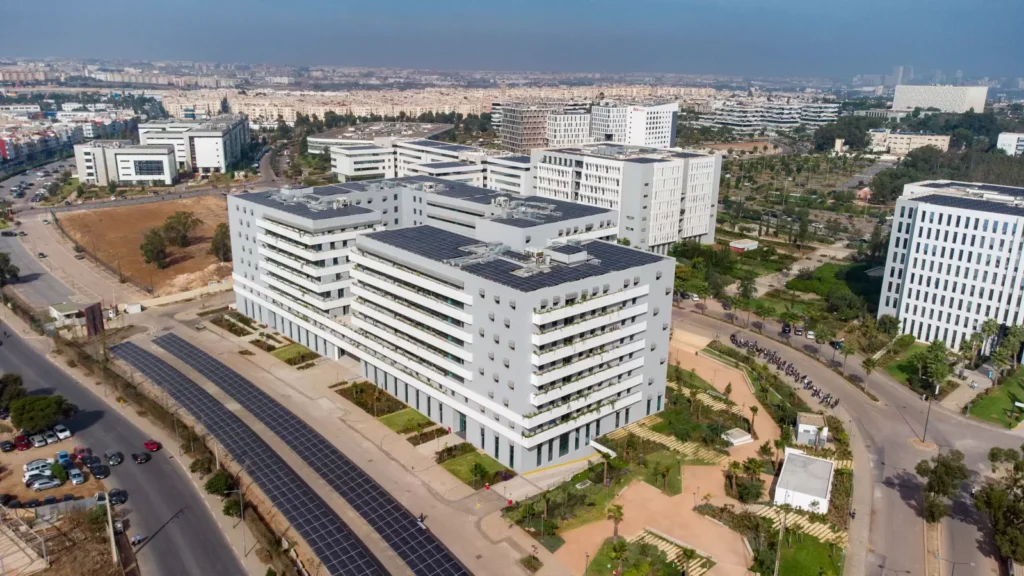
CasaNearshore and Morocco’s broader business-park infrastructure were built around the first phase of outsourcing. The second phase requires different assets.
Voice support needs seats, telecom systems and multilingual staffing. AI nearshoring needs secure cloud access, resilient power, cyber controls, development environments, data-governance protocols, high-speed connectivity, client-segregated workspaces and engineering management. That changes the real estate requirement.
The winners in Morocco’s next outsourcing cycle will not be the buildings with the most desks. They will be the campuses that can support secure digital delivery. That includes redundant connectivity, data-room discipline, cybersecurity certification, energy continuity and proximity to talent.
This has direct implications for property, telecoms and infrastructure investors. The next premium in Morocco’s office market may not come from location alone, but from whether a campus can credibly host regulated AI and cloud operations for European clients.
The Corporate Buyer
The likely buyers are not only technology companies.
Banks, insurers, telecom operators, logistics companies, utilities, retailers, industrial groups and public-sector contractors all face the same AI problem: pressure to automate and digitise without expanding high-cost Western European headcount indefinitely.
For a French insurer, Morocco can support claims automation, customer-service AI, document processing and data-cleaning workflows. For a logistics group, it can support route optimisation, analytics, cloud operations and multilingual control-room functions. For a bank, the first use cases may sit around non-core data engineering, software maintenance, reporting automation and cyber monitoring rather than highly sensitive front-office systems.
The most valuable work will move in stages. Low-risk workflows move first. Compliance-heavy work follows only after governance is proven.
That sequence is important. Morocco does not need to win the most sensitive European workloads on day one. It needs to demonstrate reliable delivery in mid-value workflows and climb the chain.
The Competitive Trap
Morocco’s risk is being trapped between cheaper offshore markets and deeper European tech clusters.
India can compete at scale. Egypt and Tunisia compete on cost and regional talent. Poland, Romania and Portugal offer EU-based engineering capacity with stronger regulatory comfort. France, Germany and the Netherlands retain senior architecture, product leadership and advanced AI research.
Morocco’s defensible lane is narrower: Europe-facing, bilingual, time-zone aligned, lower-cost, compliance-aware AI and software operations. If the country tries to compete only on price, it becomes vulnerable. If it claims to be an AI superpower before the talent and infrastructure mature, credibility weakens.
The bankable strategy is disciplined: build secure cloud-linked delivery, train technical managers, deepen data-centre capacity, strengthen compliance, and target workflows where proximity to Europe matters.
Capital Allocation Implications
This shift affects multiple asset classes.
For European corporates, Casablanca offers a potential margin-relief layer. For cloud and data-centre operators, Morocco becomes more attractive as AI and sovereign data demand grow. For office developers, the premium shifts toward secure, power-resilient campuses rather than generic BPO space. For education providers, advanced technical training becomes a monetisable bottleneck. For cybersecurity and compliance firms, Morocco’s nearshoring push creates demand for audits, certifications and managed security services.
The investment thesis is not “Morocco will become the next Silicon Valley.” That framing is lazy and wrong.
The thesis is more precise: Morocco can become the nearest lower-cost AI operations layer for parts of Europe’s digital economy, provided the country solves cloud capacity, regulatory trust, power availability and senior talent depth.
Strategic Comparison
Metric: Western European AI Delivery
Cost Structure: High salaries, social charges, retention pressure, cloud bills and compliance overhead
Operational Strength: Senior architecture, mature engineering culture, HQ proximity and deep client trust
Structural Weakness: Margin compression and limited scalability for routine AI implementation work
Metric: Casablanca-Rabat Nearshore Layer
Cost Structure: Lower delivered labour cost, improving cloud infrastructure and compatible time zone
Operational Strength: French-language depth, growing English capacity, Oracle cloud region, Mediterranean connectivity and state-backed AI strategy
Structural Weakness: Senior talent scarcity, GDPR execution risk, data-centre maturity and potential wage inflation
The opportunity is created by the spread between those two systems. Morocco does not need to replace Europe’s core technology centres. It needs to absorb the work those centres can no longer do economically at scale.
What Investors Must Watch Next
First, the Oracle utilisation signal. Investors should track whether the Casablanca cloud region becomes a production environment for banks, insurers, industrial firms and public-sector workloads, or remains mostly a symbolic infrastructure announcement.
Second, the Medusa and sovereign data-centre buildout. The investment case improves if Morocco converts submarine connectivity, fibre expansion and renewable-powered data capacity into reliable enterprise-grade hosting.
Third, the senior talent spread. The arbitrage remains bankable only if Morocco produces enough cloud architects, data engineers, cybersecurity specialists and AI delivery managers before wage inflation narrows the cost gap.
Final Outlook
Casablanca’s AI nearshoring opportunity is not a labour story anymore. It is a stack story.
The stack includes wage arbitrage, Oracle’s local cloud region, Mediterranean connectivity, sovereign data-centre plans, renewable-powered compute ambitions and a specialised academic pipeline. If these layers mature together, Morocco can move from legacy outsourcing into higher-value AI and software operations.
The upside is substantial. European companies need AI capacity, but many cannot absorb Western European cost structures indefinitely. Morocco offers a nearby, bilingual, lower-cost and increasingly infrastructure-backed alternative.
The risks are equally clear. GDPR friction can block sensitive workflows. Senior talent may run short. Data-centre capacity must scale. Renewable-powered compute must be proven. Business parks must upgrade from BPO seating to secure digital-delivery campuses.
If Morocco executes, Casablanca and Rabat can become a margin-defence corridor for Europe’s AI economy.
If it does not, the country risks rebranding legacy outsourcing with AI language while missing the higher-value work.
The winners will be the platforms that turn wage arbitrage into cloud-secure, compliance-grade delivery.
Executive Engagement
Are you operating in AI, software outsourcing, cloud infrastructure, data centres, cybersecurity, nearshoring, consulting, corporate services or Morocco-focused investment?
MMO is tracking how Casablanca and Rabat are moving from legacy outsourcing into high-value AI and software delivery for European companies.
Share your operational insights with our editorial team or contact us with data on engineering costs, client demand, GDPR compliance, cloud utilisation, AI training, data-centre capacity or nearshoring contract structures.