

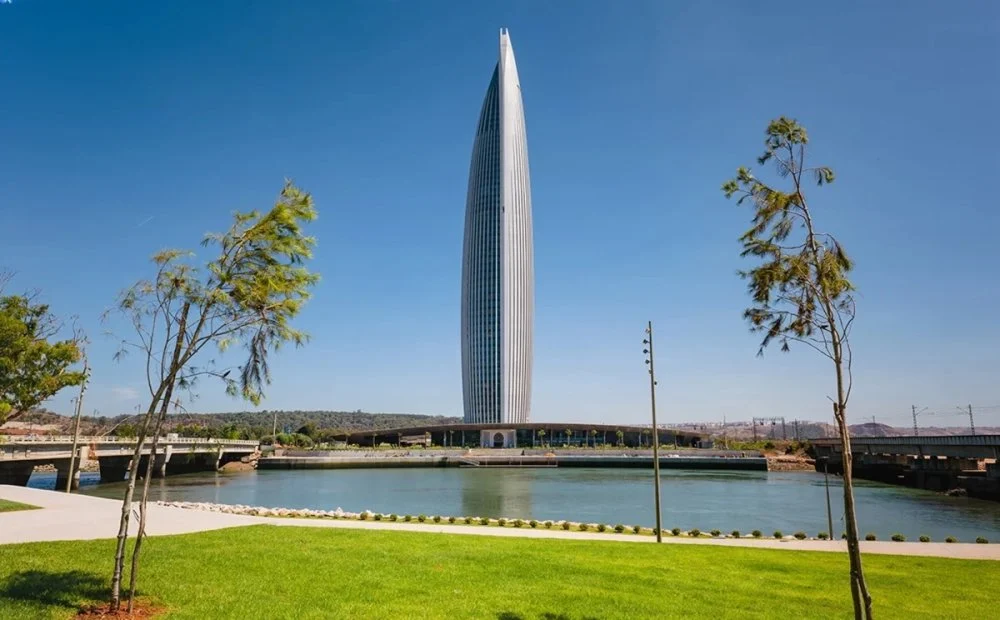
Morocco’s Atlantic Initiative is moving from diplomatic language into corridor economics: a state-led strategy designed to connect landlocked Sahel economies to global trade through Moroccan Atlantic infrastructure.
The initiative, launched by King Mohammed VI in November 2023, aims to give countries such as Mali, Burkina Faso, Niger and Chad strategic access to the Atlantic Ocean through ports, inland transit routes and energy systems.
The physical anchor is Port Dakhla Atlantique. Scheduled for operation in 2028, the port is expected to become Morocco’s deepest at 23 meters, with 1,600 hectares reserved for industrial activities and 5,200 hectares of farmland irrigated with desalinated water. The facility is designed to support heavy industries and process raw materials from Sahel countries.
The political demand signal is already visible. In April 2025, the foreign ministers of Mali, Burkina Faso and Niger endorsed Morocco’s sea-access initiative during a meeting with King Mohammed VI in Rabat.
For investors, this is not only a geopolitical story.
It is a corridor-underwriting question.
Can Morocco convert diplomatic endorsement, port capacity and inland route design into a bankable logistics system capable of moving cargo, reducing trade friction and pricing security risk across one of Africa’s most difficult operating geographies?
That is the real test of Rabat’s Atlantic Corridor.
The Baseline: A Corridor Strategy, Not a Port Offer
Morocco’s Atlantic Initiative should not be read as a simple port-access offer.
It is a corridor strategy.
Policy Center analysis describes the initiative as a state-led framework combining Atlantic port infrastructure, inland transit routes and energy systems to connect landlocked Sahelian economies to maritime access through Moroccan territory.
That distinction matters.
A port alone does not solve landlocked trade.
A landlocked economy needs road corridors, customs coordination, fuel logistics, insurance coverage, border predictability, warehousing, security guarantees and reliable transit times.
For Rabat, the Atlantic Initiative is therefore an integrated infrastructure proposition.
The objective is not only to provide access to the ocean.
It is to build an operating route for economies that historically face higher costs, longer timelines and greater political exposure when moving goods to global markets.
The Sahel Demand Signal: Route Optionality Under Pressure
The Sahel states backing Morocco’s initiative are not looking for symbolic access.
They are looking for route optionality.
Mali, Burkina Faso and Niger are all landlocked. Their trade access depends on long corridors through coastal neighbours, exposing importers and exporters to border delays, political disputes, security risks and higher logistics costs.
In April 2025, Mali, Burkina Faso and Niger publicly supported Morocco’s sea-access initiative. The three countries had already withdrawn from ECOWAS and formed the Alliance of Sahel States, increasing their need for alternative external trade routes.
For these governments, Atlantic access through Morocco offers leverage.
It does not replace traditional routes immediately.
But it creates another option for fuel, food, equipment, mining inputs, construction materials and potential exports.
That optionality has economic value.
Every credible alternative route can reduce dependency, improve negotiating power and change how trade risk is priced.
Dakhla Atlantique: The Physical Gateway
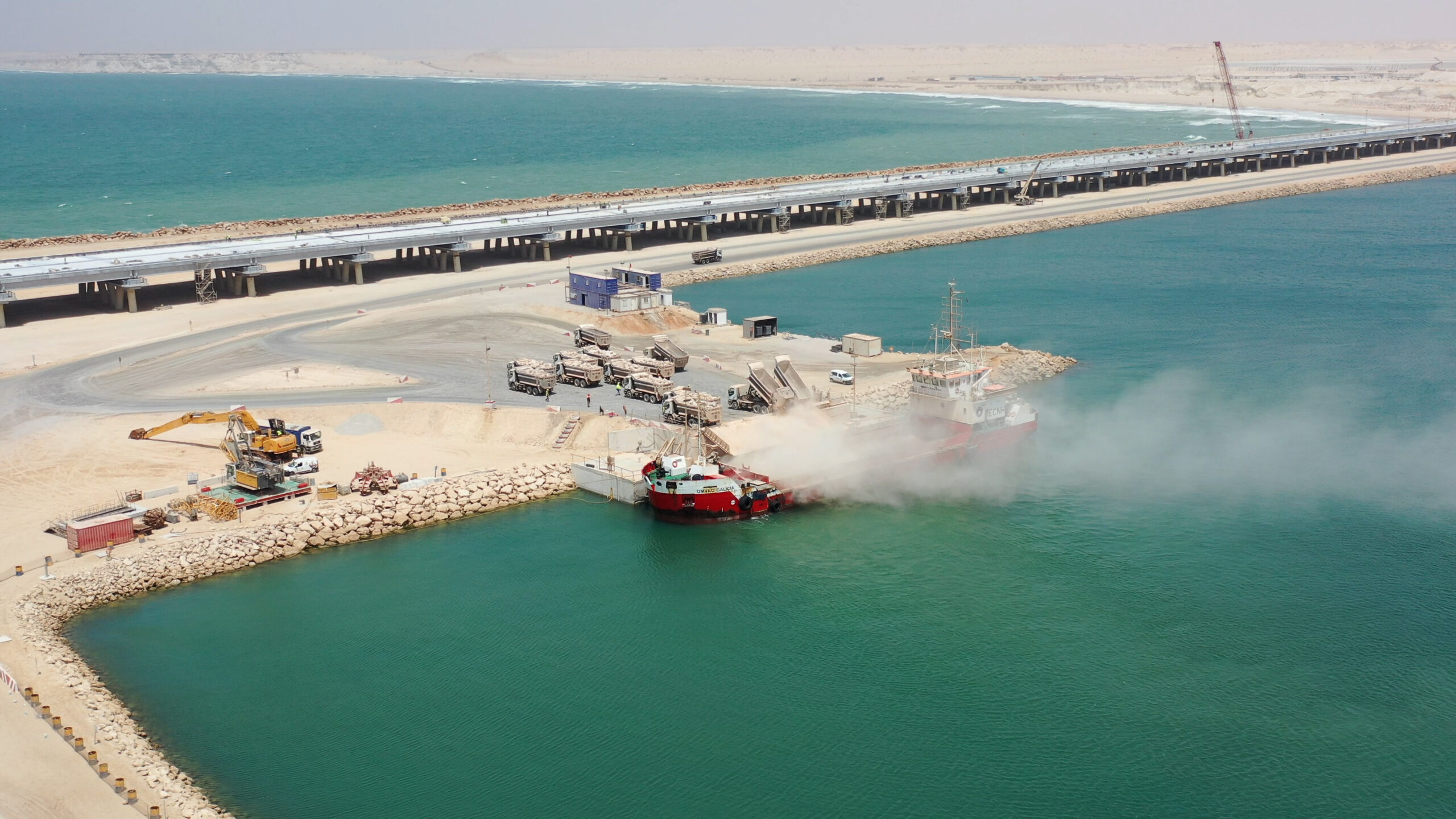
Dakhla Atlantique is the infrastructure asset that gives the Atlantic Initiative its physical weight.
The port is expected to be operational in 2028 and will be Morocco’s deepest port at 23 meters, allowing it to serve heavy industry and larger cargo flows. Its surrounding development plan includes 1,600 hectares for industrial activity and 5,200 hectares of farmland irrigated with desalinated water.
This is not a local port project.
It is a southern Atlantic platform.
The port extends Morocco’s logistics system southward and gives Rabat a maritime asset closer to West African and Sahel-facing trade routes.
The industrial land around the port is equally important.
A corridor becomes more valuable when goods are not only moved, but processed, stored, packaged, financed and redistributed.
That is where Dakhla’s industrial zone could matter.
If the zone attracts logistics operators, agri-food processors, energy players, fertiliser distributors, mining-service companies and cold-chain providers, the port can become more than a transit point.
It can become a trade-processing node.
The Operator Layer: SNTL, Timar and La Voie Express
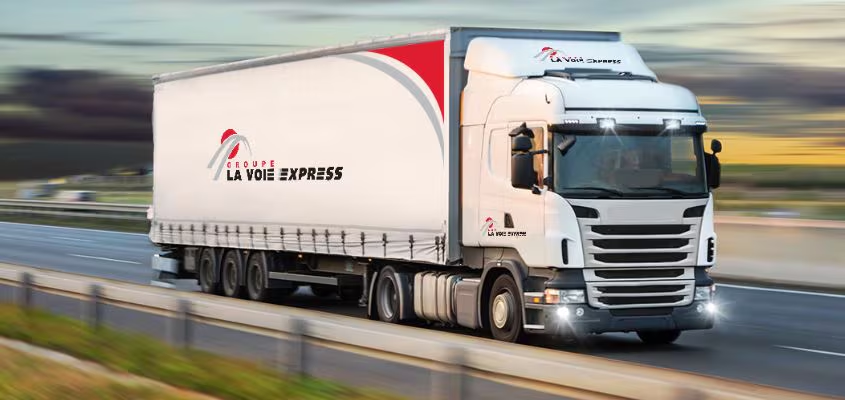
A corridor becomes credible when named operators can move cargo through it.
Morocco already has domestic logistics players with experience in road transport, freight forwarding, customs handling, warehousing and distribution.
SNTL, the Société Nationale des Transports et de la Logistique, remains one of Morocco’s central national logistics operators. The company is fully state-owned, with capital of 552 million dirhams, and its core missions include transport, logistics and management of state vehicle fleets.
Private freight groups also matter.
Timar operates in international transport, customs and logistics services across Morocco and Africa-facing routes.
La Voie Express has built an integrated logistics model covering transport, warehousing, stock management, packaging and freight services. In 2026, the group announced a logistics platform at Tanger Med in partnership with Medhub’s operator, designed to combine customs clearance, warehousing and dispatch operations.
This operator base matters for the Atlantic Corridor.
Dakhla Atlantique can provide the port asset.
But the corridor will need companies capable of managing inland movement, documentation, route risk, warehousing, customs procedures and cargo consolidation.
The question is whether these Moroccan operators can extend their capabilities southward into a more complex Sahel-facing route environment.
That is where the commercial test begins.
The Transit-Time Math: From Road Distance to Bankable Reliability
For a logistics director, corridor value is measured in days, not speeches.
The Atlantic Corridor must compete against existing routes through West African coastal ports and inland corridors that already serve Sahel markets.
Traditional routes can face long dwell times, port congestion, border delays and security-related disruption. In some West African corridors, customs processing and inland transit can stretch over multiple weeks depending on route, cargo type, security context and border conditions.
Morocco’s route thesis is based on reducing uncertainty.
The Tiznit-Dakhla expressway has already improved southern road connectivity, reducing travel time for heavy vehicles and improving road safety indicators.
A future Dakhla-to-Sahel route would still require international border coordination, Mauritanian transit reliability and onward Sahel security. But the planning logic is clear: if cargo can move from Morocco’s Atlantic coast toward inland Sahel markets on predictable road windows, the corridor can reduce warehousing costs, working-capital drag and delay risk.
The benchmark is not theoretical distance.
It is total landed cost.
That includes:
- port dwell time
- customs clearance
- border waiting time
- fuel cost
- driver security
- insurance premium
- cargo loss risk
- warehouse holding cost
- working-capital cycle
A shorter route is valuable only if it is also predictable.
That is the standard corporate planners will apply.
The Mauritania Link: Geography as the First Friction Point
The Atlantic Corridor cannot function through port capacity alone.
The inland route logic must account for Mauritania.
Mauritania sits between Morocco and several Sahel markets, making it a critical geographic and operational link in any southward corridor design. Policy Center analysis identifies Morocco-Mauritania coordination as one of the key factors shaping the viability of the initiative.
For corporate planners, this is where the trade thesis becomes technical.
A corridor requires:
- cross-border permits
- road reliability
- customs alignment
- fuel stations
- driver security
- truck insurance
- fleet maintenance
- border-processing predictability
- security coordination
Without these layers, port capacity cannot translate into predictable cargo movement.
For investors, Mauritania is therefore not an external footnote.
It is part of the corridor’s operating risk.
The Atlantic Initiative will become bankable only if inland movement is predictable enough for logistics companies, insurers, commodity traders and development finance institutions to price the route.
The Monetary and Customs Friction: MAD, XOF and Transit Bonds
The Atlantic Corridor will also have to solve financial plumbing.
For corporate planners, the friction point is not only road quality.
It is clearing mechanics.
Morocco operates in Moroccan dirhams. Mali, Burkina Faso and Niger use the West African CFA franc, or XOF. Cross-border trade between MAD-based operators and XOF-zone buyers requires banking coordination, currency conversion, settlement timing and documentation discipline.
That affects working capital.
A shipment delayed by customs or payment verification can trap liquidity inside the route.
The customs layer is equally important.
International cargo corridors require transit documentation, guarantees and customs-bond frameworks that allow goods to move through one jurisdiction toward another without being treated as local imports at each stage.
If these ledgers are not standardised, logistics operators face delays, duplicate paperwork and higher compliance costs.
For the Atlantic Corridor to scale, Morocco and its partners will need:
standardised customs documents
digital transit ledgers
bank-recognised guarantees
harmonised cargo declarations
insurance-compatible route protocols
clear procedures for bonded transit
These are not technical footnotes.
They determine whether CFOs trust the corridor.
The Security Premium: The Route Has to Be Insurable
Every trade corridor has a risk price.
In the Sahel, that price is high.
Political instability, insurgent activity, military transitions, shifting alliances and border friction all affect logistics viability.
The security challenge is not theoretical. In 2025, four Moroccan truck drivers transporting electrical equipment from Casablanca to Niamey were kidnapped in northeastern Burkina Faso and later released after regional security cooperation.
For investors and freight operators, that incident illustrates the corridor’s core friction point.
A route is not commercially viable because it appears on a map.
It must be insurable.
Insurers, cargo owners and freight companies will need evidence that transit can be secured, monitored and priced at a level that does not destroy the corridor’s cost advantage.
The commercial test is therefore clear:
Can operators move goods safely?
Can insurance be priced competitively?
Can route delays be controlled?
Can drivers, trucks and cargo be protected?
Can customs and security agencies coordinate across borders?
If those conditions improve, the corridor becomes more than a political project.
It becomes an investable route.
The Cargo Thesis: Food, Fuel, Fertilisers and Mining
The Atlantic Corridor will not be judged by diplomatic communiqués.
It will be judged by cargo.
The most likely early cargo categories are practical, not glamorous.
Landlocked Sahel economies require stable access to:
fuel
food imports
fertilisers
construction materials
mining equipment
industrial inputs
electrical equipment
consumer goods
On the export side, mining and raw materials could become a major driver if route economics work.
Dakhla Atlantique’s projected depth and industrial land are relevant here because heavy-industry processing and bulk cargo require deep-water access, storage space and industrial zoning.
For Morocco, the opportunity is to turn corridor access into service revenue.
That includes trucking, freight forwarding, warehousing, cold chain, customs brokerage, fuel logistics, port handling, financing and insurance-linked services.
The trade corridor becomes valuable when cargo flows become repeatable.
OCP Africa and the Food-Security Supply Chain
Fertilisers are a natural corridor category.
Morocco’s OCP Group is one of the world’s largest phosphate and fertiliser players, and African agriculture has long been part of its strategic market logic.
OCP Africa has built a continent-wide approach focused on customised fertiliser solutions, farmer support and local agricultural partnerships. The group has reported reaching more than 2 million farmers through its African initiatives and has dedicated large fertiliser volumes to strengthen food security across the continent.
This matters for the Atlantic Corridor.
For Sahel economies, fertiliser access affects food security, crop yields, rural productivity and import dependency.
A reliable Atlantic route could support the movement of fertilisers, seeds, equipment and agricultural inputs toward inland markets.
The corridor could also support reverse flows linked to agri-food, livestock, cotton or other Sahel-origin commodities if logistics economics become competitive.
The strategic point is not simply that OCP sells fertiliser.
It is that Morocco already has an agricultural-supply-chain actor with African distribution logic.
The Atlantic Corridor could tighten that logic by improving access between Moroccan bulk supply, Dakhla-linked logistics and inland Sahel demand.
Energy Systems: The Second Layer of the Corridor
Policy Center analysis places energy systems alongside ports and inland routes as one of the pillars of Morocco’s Atlantic Initiative.
That is important.
Sahel economies need more than maritime access.
They need fuel logistics, electricity access, mining energy, cold-chain power, industrial utilities and eventually cleaner energy systems.
Morocco’s broader Atlantic project pipeline gives the initiative additional depth.
Dakhla Atlantique is expected to include facilities linked to green hydrogen exports, while Morocco’s wider port expansion includes Nador West Med, LNG infrastructure and future energy corridors.
Not all of these assets will mature at the same speed.
But the direction is clear.
Rabat is not building isolated infrastructure.
It is trying to connect ports, energy, logistics and industrial geography into a wider Atlantic operating system.
Investor Monetization Logic
For investors, Rabat’s Atlantic Corridor creates potential opportunities across several layers.
The first is logistics.
Freight forwarding, trucking, customs brokerage, route management, driver services, maintenance depots and cargo insurance could become investable if the corridor begins moving regular volumes.
The second is industrial real estate.
Dakhla’s industrial land could attract storage, processing, packaging, agri-logistics, mining-service and energy-support businesses.
The third is food and fertiliser logistics.
A corridor serving Sahel markets could support fertiliser distribution, grain handling, cold chain and agricultural-input platforms.
The fourth is mining support.
Sahel economies have mining and raw-material flows that require equipment imports, bulk handling and export corridors.
The fifth is development finance.
If the route proves politically durable and commercially useful, multilateral lenders and development finance institutions may help finance road, customs, energy and logistics infrastructure.
The corridor is not yet a fully priced asset class.
But it has the ingredients of one.
The Regulatory and Operational Friction
The Atlantic Corridor will need more than political support.
It will need operational rules.
The friction points are clear:
customs harmonisation
transit permits
truck insurance
cargo security
border processing
tariff transparency
fuel access
road maintenance
dispute resolution
foreign-exchange handling
port handling fees
These details determine whether companies use a corridor or avoid it.
For a logistics director, a route with uncertain customs processing and high insurance costs can be less attractive than a longer route with predictable execution.
For a CFO, corridor value is not measured only in kilometres.
It is measured in total landed cost, working-capital cycle, insurance premium, delay risk and cargo-loss probability.
That is the level at which Morocco’s Atlantic Initiative will be tested.
MMO Atlantic Corridor Matrix: 2026
Atlantic Initiative
2026 market signal: Morocco’s initiative aims to connect landlocked Sahel economies to maritime access through Atlantic ports, inland transit routes and energy systems.
Investor value: creates a new trade-access framework for economies structurally constrained by geography.
Execution test: converting diplomatic endorsement into operational cargo flows.
Operator base
2026 market signal: SNTL, Timar and La Voie Express provide an existing Moroccan logistics base across transport, customs, warehousing and freight services.
Investor value: named domestic operators can support future corridor execution.
Execution test: extending capabilities into higher-risk Sahel-facing routes with insurance and customs reliability.
Dakhla Atlantique
2026 market signal: expected operation in 2028; 23-meter depth; 1,600 hectares for industry; 5,200 hectares of desalination-irrigated farmland.
Investor value: southern Atlantic gateway for logistics, bulk cargo, industry, fisheries, agri-business and regional trade.
Execution test: cargo generation, inland connectivity, industrial-zone absorption and operator adoption.
Monetary and customs plumbing
2026 market signal: cross-border trade must bridge MAD-based Moroccan operators and XOF-zone Sahel buyers.
Investor value: standardised payments, bonded transit and customs ledgers can lower friction.
Execution test: digital documentation, bank guarantees, insurance protocols and customs synchronisation.
Energy and food-security layer
2026 market signal: OCP Africa and Morocco’s energy-port strategy align naturally with Sahel fertiliser, fuel and agri-logistics demand.
Investor value: corridor could support fertilisers, cold chain, mining services, fuel logistics and agricultural inputs.
Execution test: matching port capacity with real inland demand and service reliability.
What Investors Should Watch Next
Investors should monitor five signals.
First, whether Morocco and Sahel governments move from political endorsement to signed operational protocols.
Second, whether Dakhla Atlantique remains on schedule and attracts credible port-linked operators before opening.
Third, whether inland routes through Mauritania and onward toward Sahel markets become secure, insured and commercially viable.
Fourth, whether logistics operators, insurers and development finance institutions begin treating the corridor as a bankable route.
Fifth, whether cargo demand emerges from real sectors such as fuel, food imports, fertilisers, mining equipment and industrial goods.
These signals will determine whether Rabat’s Atlantic Corridor becomes a geopolitical statement or a functioning trade platform.
Final Outlook
Morocco’s Atlantic Initiative is one of the most ambitious elements of Rabat’s Africa strategy.
It targets a hard economic problem: how landlocked Sahel economies reach global markets more efficiently.
For Morocco, the initiative strengthens the country’s role as an Atlantic gateway, logistics platform and strategic partner for African development.
For Sahel states, it offers route diversification and potential access to new trade infrastructure.
For investors, the opportunity lies in the corridor economy that could form around ports, roads, logistics, energy, fertilisers, food security and mining flows.
The upside is significant.
But the execution burden is high.
The Atlantic Corridor will be judged by cargo movement, route security, customs performance, insurance pricing and commercial adoption.
That is where Rabat’s next African trade advantage will be tested.
Executive Engagement
Are you operating in logistics, infrastructure finance, mining, fertilisers, agri-food, energy or West African trade corridors?
MMO is tracking how Morocco’s Atlantic Initiative moves from diplomatic framework to operational corridor.
Share your operational insights with our editorial team or contact us with corridor-level data, logistics challenges or investment observations.