

Morocco holds one of Africa’s rarest trade positions: it is the only country on the continent with a free trade agreement with the United States while also operating a free trade area with the European Union.
That dual-access structure gives Morocco a legal and industrial advantage at a time when manufacturers are reconfiguring supply chains around proximity, rules of origin, carbon compliance and geopolitical risk.
The U.S.-Morocco Free Trade Agreement entered into force in 2006 and remains the only U.S. free trade agreement on the African continent, according to the U.S. Commercial Guide. The EU-Morocco Association Agreement entered into force in 2000 and created a free trade area between Morocco and the European Union.
For investors, the significance is direct.
Morocco is not only near Europe.
It has treaty-based access to Europe, a formal FTA channel into the United States and an expanding industrial base capable of converting that legal access into export volume.
The commercial question is no longer whether Morocco is strategically located.
The question is whether companies can structure Moroccan production to meet origin rules, compliance requirements and delivery standards across two of the world’s most valuable markets.
The Baseline: Treaty Access Backed by Industrial Scale
Morocco’s trade advantage rests on three layers: geography, infrastructure and law.
The geography is clear. Morocco sits across from Europe, faces both the Atlantic and the Mediterranean, and connects production to major maritime routes.
The infrastructure is now measurable. Tanger Med handled 11.1 million TEUs in 2025, up 8.4% from 2024, while total cargo across the port complex reached 161 million tons. The port also handled 535,203 TIR trucks and more than 526,000 vehicles through its vehicle terminals in 2025.
Hero image placement for layout:
Insert a wide-angle hero visual here showing Tanger Med containers, port cranes or logistics infrastructure. The image should communicate industrial scale, export capacity and supply-chain depth — not tourism or generic skyline visuals.
The legal layer is what turns logistics into market access.
Morocco’s trade agreements give companies operating from the country a structured framework for exporting to Europe and the United States, provided they meet the relevant rules of origin and documentation requirements.
This is where Morocco differs from many African manufacturing destinations.
It is not relying only on proximity or labour-cost arbitrage.
It has built a market-access architecture that can be monetised by companies able to meet compliance standards.
The Corporate Proof: Renault, Stellantis, Safran and the Battery Chain
Morocco’s treaty advantage is not theoretical.
It is visible in the companies already operating on the ground.
Renault Group’s Moroccan industrial footprint spans Tangier and Casablanca. Its Moroccan operations produced around 394,000 vehicles in 2025, with the Tangier plant accounting for nearly 299,000 units and the Casablanca SOMACA facility contributing about 95,000 units.
Stellantis is expanding its Kenitra plant through a €1.2 billion investment plan that will raise annual capacity to 535,000 vehicles. Morocco’s automotive exports reached a record 151.5 billion dirhams in 2024, maintaining its position as the country’s leading industrial export engine, before surging toward 154.5 billion dirhams in 2025.
Aerospace gives the trade story a higher-value layer.
Safran is investing heavily near Casablanca, including a €200 million Airbus engine assembly line expected to produce 350 LEAP-1A engines per year, as well as a €280 million landing gear plant linked to Airbus A320 supply chains.
The battery chain is now entering the same corridor logic.
Chinese EV battery materials groups such as BTR New Material Group, CNGR Advanced Material, Gotion High-Tech and Hailiang are placing capital into Morocco’s industrial ecosystem, attracted by the country’s automotive base, renewable energy potential, logistics and trade access. Gotion’s announced Moroccan gigafactory alone carries an initial investment of $1.3 billion, with potential future expansion substantially higher.
This corporate map is the real signal.
Morocco has moved from policy aspiration to operating ecosystem.
The Cost-Arbitrage Equation
For European manufacturers, Morocco’s appeal is not only treaty access.
It is the arithmetic of nearshoring.
Morocco’s legal minimum wage for the non-agricultural private sector increased to 3,422.72 dirhams per month in 2026, approximately $340 or €315. Depending on working hours and sector structure, that translates into a significantly lower base labour-cost environment than most Central and Eastern European nearshoring competitors.
By comparison, industrial labour costs in countries such as Poland, Romania, Hungary or the Czech Republic are materially higher once wages, social charges and overhead are included.
That gap matters for CFOs.
A manufacturer moving part of its production from Eastern Europe or Asia to Morocco is not only evaluating wages. It is calculating:
- labour cost
- logistics time
- tariff treatment
- working-capital cycles
- inventory risk
- compliance cost
- energy sourcing
- supplier reliability
Tanger Med gives the model additional weight.
Direct maritime connectivity to Spain and wider European logistics corridors can reduce transit times compared with distant Asian production bases, while keeping labour costs structurally below many European alternatives.
The arbitrage is not only cheap labour.
It is labour cost plus market access plus delivery speed.
The U.S. FTA: Morocco’s Atlantic Differentiator
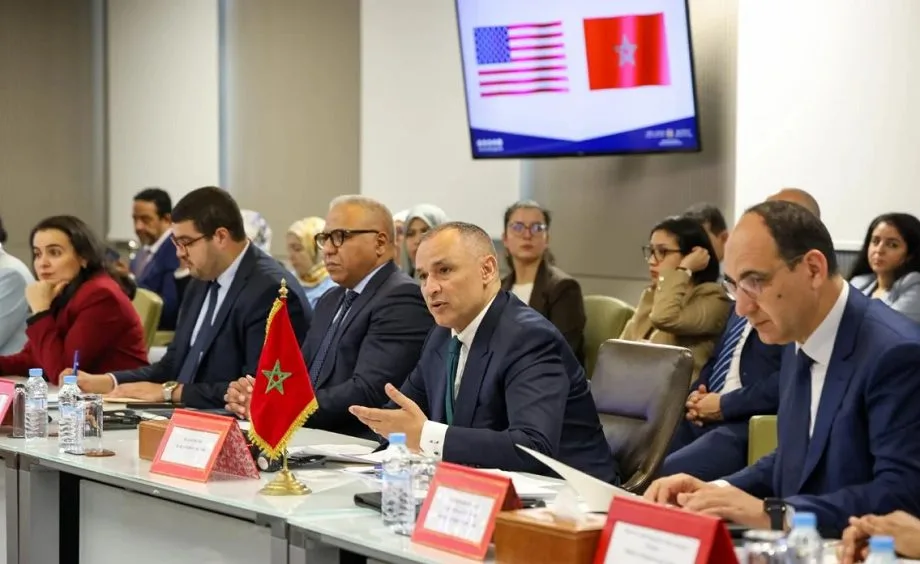
The U.S.-Morocco Free Trade Agreement is Morocco’s most distinctive Atlantic trade asset.
The agreement entered into force in 2006 and covers intellectual property, labour, environmental protection, transparency, investment rights and goods-market access. U.S. companies also enjoy the same rights as Moroccan companies when investing in the country.
For international manufacturers, the United States is not simply another export destination.
It is a high-value market with strict compliance requirements, product standards, documentation rules and legal expectations.
Morocco’s FTA gives companies a treaty framework.
But treaty access is not automatic commercial success.
Exporters must still prove origin, meet product standards, manage logistics and compete on price, quality and delivery reliability.
That is why the FTA is best understood as an institutional advantage, not a shortcut.
It opens the door.
Industrial execution determines whether companies can walk through it.
The EU Layer: Morocco’s Primary Commercial Anchor
Europe remains Morocco’s primary external market.
The EU-Morocco Association Agreement created a free trade area and anchors Morocco’s largest trade and investment relationship.
The European Commission describes the EU as Morocco’s leading trade partner and its biggest foreign investor.
For manufacturers, the value is operational.
Morocco can serve European markets faster than Asian production bases while offering competitive labour costs, maturing industrial zones and proximity to EU-linked supply chains.
This is the logic behind Morocco’s nearshoring appeal.
A company can locate production in Morocco, serve European demand faster and reduce exposure to long-distance freight volatility.
But the European layer is becoming more demanding.
EU buyers increasingly care about emissions, traceability, labour standards, product certification and supplier transparency.
Morocco’s advantage will depend not only on tariff access, but on whether its industrial ecosystem can meet European compliance expectations.
Rules of Origin: The Fine Print Behind the Advantage
Free trade agreements do not work automatically.
They work when companies satisfy rules of origin.
A product assembled in Morocco does not automatically qualify for preferential access just because it leaves a Moroccan port.
Exporters must prove that the product meets the value-added or transformation requirements of the relevant agreement.
This is where mid-sized manufacturers often underestimate the complexity.
Under U.S. trade rules, certain textile and apparel products are subject to strict origin provisions, including the yarn-forward rule, which generally requires yarn and fabric to originate within the FTA region for qualifying goods.
Other sectors may need to demonstrate substantial transformation or sufficient local value added.
For CFOs and legal counsels, the question is technical:
Can enough value be added locally?
Are Moroccan suppliers deep enough?
Can imported inputs be transformed sufficiently?
Are customs documents reliable?
Can origin claims survive audit?
Can compliance teams manage both EU and U.S. requirements?
This is where Morocco’s industrial ecosystem becomes decisive.
The deeper the supplier base, the easier it becomes to qualify for preferential access.
The weaker the local value chain, the harder it becomes to monetise the treaty advantage.
Trade agreements reward industrial depth.
They do not replace it.
Green Power and the CBAM Hedge
The next stage of market access will be shaped by carbon and traceability.
For European buyers, low-cost production is no longer enough.
Exporters must increasingly manage emissions, energy sourcing, product traceability and supply-chain transparency.
This is where Morocco’s renewable energy framework becomes part of the trade advantage.
Morocco’s Law 13-09 on renewable energy opened the market to private renewable-energy production. Later reforms expanded the framework, including opportunities for direct sales of renewable electricity to eligible end consumers and access to grid infrastructure.
For industrial exporters, this matters because renewable power can become a compliance tool.
An automotive supplier, battery materials producer or heavy industrial operator serving Europe may increasingly need to demonstrate lower-carbon electricity sourcing to protect competitiveness under European carbon and traceability rules.
Direct renewable power purchase agreements, where available and bankable, can help industrial consumers reduce carbon exposure and strengthen export documentation.
This is not only an energy story.
It is a trade story.
The stronger Morocco’s renewable electricity integration becomes, the more valuable its Europe-facing industrial platform becomes.
The Investor Monetization Logic
For investors, Morocco’s trade advantage can be monetised in several ways.
The first is export manufacturing.
Companies can use Morocco as a production base for Europe-facing or U.S.-facing goods where rules of origin can be met.
The second is supplier localisation.
As Renault, Stellantis, Safran and battery-materials manufacturers increase local sourcing, opportunities open for component producers, packaging firms, logistics operators, testing services and compliance consultants.
The third is logistics and warehousing.
As export flows increase, companies need bonded storage, customs-linked services, freight forwarding, cold chain, vehicle logistics and documentation support.
The fourth is compliance infrastructure.
Rules of origin, carbon reporting, EU traceability and U.S. product standards create demand for technical advisory, certification and audit services.
The fifth is industrial real estate.
Factories, logistics parks, serviced land and utility-ready platforms become valuable when trade access supports long-term manufacturing demand.
This is why Morocco’s trade framework matters beyond exporters.
It creates a wider service economy around export readiness.
Africa as the Third Layer
Morocco’s trade position is not limited to Europe and the United States.
The country is also building an Africa-facing platform through banking, insurance, telecoms, construction, fertilisers, logistics and diplomacy.
The U.S. Commercial Guide notes that Morocco has preferential trade agreements with 62 countries and highlights the African Continental Free Trade Area as a long-term framework for continental trade integration.
For Morocco, this creates a layered trade identity.
It is Europe-facing.
It is Atlantic-facing.
It is Africa-facing.
That gives the country a more complex investment profile than a simple low-cost manufacturing base.
A company in Morocco can think in several directions at once: Europe for proximity, the United States for treaty-based Atlantic access and Africa for growth.
This is the platform logic.
The CFO Risk Matrix
Morocco’s trade advantage is strong, but investors must avoid a common mistake.
Market access is not the same as export competitiveness.
A CFO recalculating a supply chain around Morocco must underwrite:
rules of origin
supplier depth
labour availability
energy and water access
customs execution
industrial land
port reliability
documentation systems
carbon compliance
foreign-exchange procedures
local management quality
The strongest investment cases will be in sectors where Morocco has both treaty access and operational capability.
Automotive and aerospace have already shown this model.
The next wave will test whether Morocco can extend it into EV components, batteries, electronics, renewable-energy equipment, agri-food and higher-value industrial services.
That is where the real upside sits.
MMO Morocco Trade Advantage Matrix: 2026
U.S. free trade agreement
2026 market signal: Morocco remains the only African country with a U.S. FTA, in force since 2006.
Investor value: treaty-based Atlantic access for companies able to meet origin and compliance rules.
Execution test: U.S. product standards, origin audits, documentation and sector-level competitiveness.
EU free trade area
2026 market signal: the EU-Morocco Association Agreement created a free trade area and anchors Morocco’s largest trade relationship.
Investor value: nearshoring, faster delivery cycles and proximity to Europe’s industrial supply chains.
Execution test: EU rules of origin, carbon reporting, traceability and supplier depth.
Corporate industrial base
2026 market signal: Renault, Stellantis, Safran, BTR, CNGR, Gotion and Hailiang are building or expanding Moroccan industrial exposure.
Investor value: proof that Morocco can convert market access into export-oriented industrial scale.
Execution test: local sourcing, EV transition, engineering talent and supplier localisation.
Tanger Med logistics platform
2026 market signal: Tanger Med handled 11.1 million TEUs and 161 million tons of cargo in 2025.
Investor value: scaled port capacity, vehicle logistics and industrial export reliability.
Execution test: inland connectivity, customs throughput and capacity management as volumes rise.
Green power / CBAM hedge
2026 market signal: Law 13-09 and renewable-energy reforms support private renewable generation and direct power-sales frameworks.
Investor value: potential lower-carbon electricity sourcing for EU-bound exporters.
Execution test: bankable PPAs, grid access, emissions documentation and certification.
What Investors Should Watch Next
Investors should monitor five signals.
First, whether Morocco raises local value added in export sectors rather than remaining dependent on imported inputs.
Second, whether new manufacturers can meet EU and U.S. rules-of-origin thresholds.
Third, whether Tanger Med and inland logistics remain efficient as volumes expand.
Fourth, whether renewable energy access becomes a measurable advantage for Europe-facing manufacturers.
Fifth, whether Morocco attracts higher-value industrial projects rather than only final assembly.
These signals will determine whether Morocco’s free-trade advantage becomes a durable industrial moat.
Final Outlook
Morocco’s trade advantage is not built on geography alone.
It is built on treaty access, industrial platforms and logistics execution.
The country offers a combination that few African economies can match: a free trade area with the European Union, the only U.S. free trade agreement on the African continent and a functioning export base anchored by automotive, aerospace, battery materials and logistics.
For investors, this changes the Morocco thesis.
The country is not simply a nearshore alternative.
It is a treaty-backed platform for companies trying to serve multiple markets from one operating base.
The upside is clear.
But the execution test is technical.
Rules of origin, supplier depth, customs performance, carbon documentation, labour-cost discipline and local value added will determine which companies can turn Morocco’s trade architecture into real export profitability.
That is where Morocco’s next industrial advantage will be won.